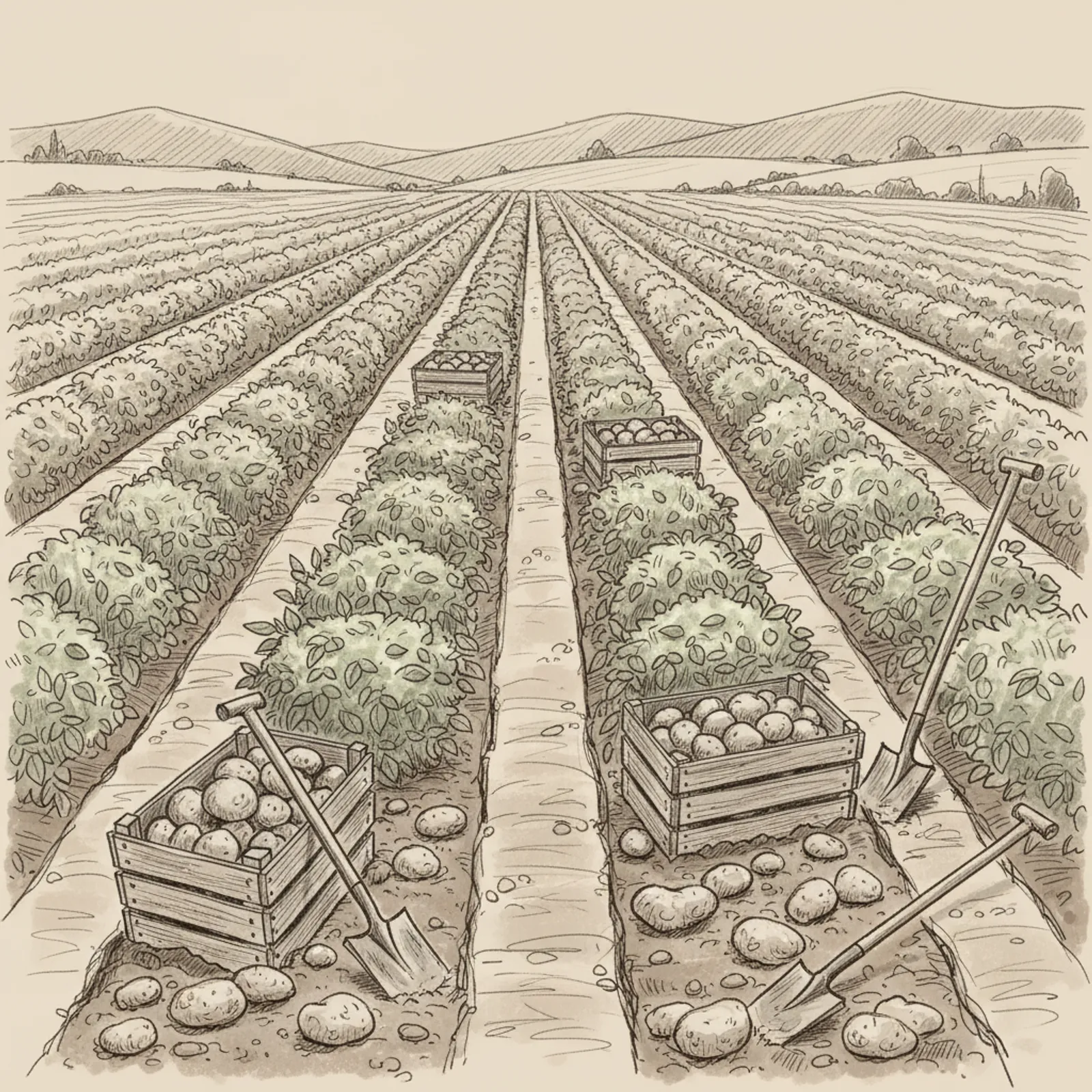
A practical field-to-storage guide for one of the most globally adapted red-skinned potato varieties. Spacing, water, disease, harvest, and storage.
Desiree is grown across very different climates on four continents for a reason: it handles variable conditions better than many specialist lines. Bred in the Netherlands in 1962 (a cross of Urgenta and Depesche), it’s proven itself across maritime, continental, and Mediterranean growing zones.
Whether you’re planting 10 seed potatoes in a back garden or managing a 20-hectare field, the core principles are the same: start with certified seed, protect emergence, manage water around tuber initiation, and give the crop enough time for proper skin set before harvest.
Variety profile at a glance
Desiree Growing Specs
| Attribute | Value | Practical note |
| Maturity | Maincrop (18-20 weeks) | Later than first earlies; more yield per plant |
| Skin colour | Pink-red | Distinctive; holds colour through storage |
| Flesh colour | Pale creamy-yellow | Not white, not deep yellow — in between |
| Dry matter | ~21.5% | Type B all-purpose; balanced starch |
| Tuber shape | Oval to long-oval | Uniform sizing; good packout ratio |
| Eye depth | Shallow to medium | Easy to prepare; minimal waste |
| Drought tolerance | Good to very good | Better than most maincrops |
| Yield potential | Medium-high | 35-50t/ha under good conditions |
| Dormancy | Medium-long | Stores well into spring with proper conditions |
Step 1: Seed selection and chitting
Always use certified seed. This is the single most important decision you make. Certified seed has been inspected for viruses (PVY, PVX, PLRV), bacterial diseases (blackleg, ring rot), and trueness to variety. Farm-saved seed accumulates disease load — yield declines of 30-50% within 3-4 seasons are well documented in literature.
Chit (pre-sprout) seed potatoes 4-6 weeks before planting. Place seed tubers upright (rose end up — the end with the most eyes) in egg cartons or seed trays in a cool (8-12°C), light place. You want short, sturdy, green-purple sprouts of 1-2cm. Long, pale sprouts grown in darkness are weak and break during planting.
Practical advantage
Why chitting matters
Chitting gives Desiree a 2-3 week head start. This is especially valuable in shorter growing seasons or cooler climates. The sprouts establish faster after planting, leading to earlier canopy closure and better competition against weeds.
Step 2: Soil preparation and planting
Soil requirements. Desiree performs best in well-drained, fertile soil with a pH of 5.5-6.5. Heavy clay is manageable if drainage is adequate, but waterlogged soil causes rot. Sandy soils work well but need more irrigation. Add well-rotted compost or manure in autumn before spring planting — fresh manure promotes scab.
Planting depth and spacing:
- Depth: 10-15cm below soil surface
- In-row spacing: 30-35cm
- Row spacing: 60-75cm (wider rows make hilling easier)
- Soil temperature at planting: minimum 8-10°C at 10cm depth
Timing varies by region:
- UK and Northern Europe: Late March to mid-April
- Mediterranean / Southern Europe: February to March (autumn planting also possible)
- Australia / New Zealand: September to November
- North America (temperate): After last frost date, typically April-May
Step 3: Growth management
Hilling (earthing up). When shoots reach 15-20cm, draw soil up around the stems to create a ridge. This prevents tuber greening (caused by light exposure), protects developing tubers from frost and blight spores, and increases the volume of soil available for tuber formation. Hill twice: once at 15-20cm shoot height, again 2-3 weeks later.
Water management. Desiree has documented good drought tolerance — better than most maincrops — but still responds to consistent moisture, particularly during tuber initiation (roughly 6-8 weeks after emergence). The critical period is flowering through early tuber bulking.
- Avoid irrigation swings: alternating wet and dry causes growth cracks and hollow heart
- Target 25-35mm per week during active growth (from rainfall + irrigation)
- Reduce watering 2-3 weeks before harvest to help skin set
Fertilisation. Desiree has moderate nitrogen needs. Over-fertilisation with N produces excessive haulm (foliage) at the expense of tuber quality and delays maturity.
- Apply 100-150 kg/ha nitrogen for commercial crops (or 150g per m² for gardens)
- Potassium is critical for tuber quality and skin colour — apply potassium sulphate rather than chloride
- Phosphorus supports early root development
Step 4: Disease and pest management
Desiree Disease Resistance Profile
| Disease | Resistance level | Management approach |
| Late blight (foliage) | Moderate | Scout regularly; fungicide programme if needed |
| Late blight (tuber) | Good | Hilling and haulm removal reduce tuber infection |
| Potato virus Y (PVY) | Good | Certified seed eliminates most virus pressure |
| Common scab | Moderate | Maintain soil pH below 6.0; irrigate during tuber set |
| Potato cyst nematode | Susceptible (Ro1) | Rotate with non-host crops; test soil before planting |
| Blackleg | Moderate | Use certified seed; remove affected plants |
Rotation is essential. Never grow potatoes in the same ground more than one year in four. Rotation breaks disease cycles, reduces nematode populations, and maintains soil health. Follow potatoes with cereals, legumes, or brassicas.
Step 5: Harvest and curing
Timing. Desiree is ready for harvest 18-20 weeks after planting. Signs of maturity:
- Foliage begins to yellow and die back naturally
- Skin is firm — rub your thumb against the tuber surface; if the skin doesn’t scrub off, it’s set
- Tuber size has stabilised (check by lifting one plant as a test)
Haulm management. For commercial crops, destroy the haulm (either mechanically or chemically) 2-3 weeks before harvest. This stops tuber growth at a uniform size and allows the skin to thicken in the soil. For home gardens, simply wait for natural die-back.
Harvest on a dry day. Wet harvest conditions spread bacterial diseases and make curing harder. Lift carefully to avoid bruising — damaged tubers don’t store well.
Cure immediately after harvest. Hold tubers at 12-15°C with high humidity (85-90%) for 10-14 days. This allows minor wounds to heal (suberisation) and excess moisture to evaporate. Curing is the step that determines storage longevity.
Step 6: Storage
Long-term storage conditions:
- Temperature: 4-8°C (lower for seed, higher for ware)
- Humidity: 85-95%
- Darkness: complete (light causes greening / solanine production)
- Ventilation: gentle airflow to prevent condensation
Desiree has medium-long dormancy, meaning it stores well into spring under proper conditions without sprouting. This makes it practical for both commercial storage and home root cellars.
Expect 4-6 months of quality storage in appropriate conditions. If tubers start sprouting, temperatures may be too high. If tubers shrivel, humidity is too low.
Home garden vs. commercial: what changes
The variety doesn’t change. The principles don’t change. What changes is scale and monitoring intensity:
- Home garden: 10-20 seed potatoes, manual hilling with a hoe, hand watering, visual disease scouting, fork-lift harvest. You can grow excellent Desiree in raised beds, containers, or traditional rows.
- Commercial: mechanical planting and hilling, scheduled irrigation, fungicide programmes, graded harvest, controlled-atmosphere storage. Desiree’s uniform tuber shape gives good packout ratios at commercial scale.
Either way, certified seed and proper rotation are non-negotiable. Everything else adapts to your context.